   |
||
| Homepage «« Accomodation «« Location and climate «« History «« Water world «« Reservations «« |
||
|
History In the very heart of Dalmatia, topped with rocky mountain Biokovo, trimmed with golden beaches and blue sea dress, are situated Tucepi, a turistic pearl of Makarska Riviera. But Tucepi are not just a contemporary turistic centre, they are its olive-groves, vineyards and pine groves, and above all its stony hamlets and neighborhoods, which each on its way tells ancient fishing and labourers’ legends, which Dalmatia knew to decant, in just her known way, in a song. |
||
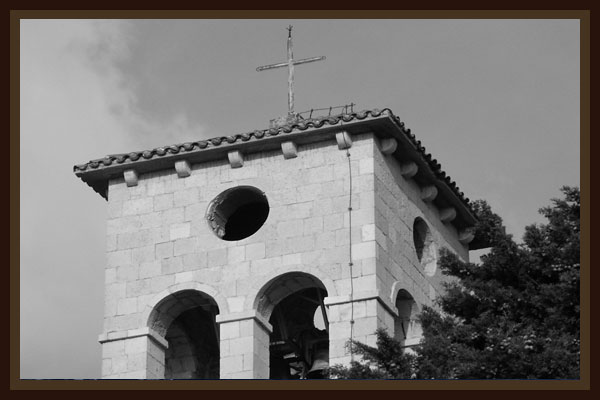
The hamlets of Tučepi: Podpeć. Čovići, Srida sela, Šimići and Podstup, built in traditional Mediterranean style, are spread over a large area of coastal limestone slopes. Rich in natural water springs, the area abounds with terraced eardens, vineyards and olive-groves. The modern village of Tučepi, situated in the south of the area. along the four kilometres of mild, cultivated pebbly shore, seeks its prosperity in tourism. The very name of the place witnesses its long history tracing back to the Prehistoric period (Illyrians, 2000 BC - 1st cent. AD). |
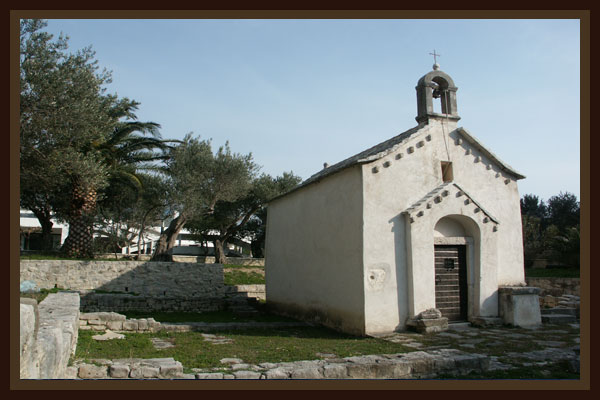  |
Besides the localities mentioned above, there are others that represent further evidence of the continuity of life in the Tučepi area. One of them, the church called Crkva Gospina rođenja (the church of Our Ladys Birth) is situated on the local cemetery in the south-east, above the coastal motorway). The other one, called Crkva svetog Jure (St. George'church). situated in the southwest of the village, is surrounded by the present-day hotel complex. St.George's church was built in 1311 and it has been preserved as a one-nave Romanesque-Gothic building with a semicircular apse. In the interior of the church everal consecration crosses, decorated in paint, have been preserved as well. Having been thoroughly explored by archaeologists and restorers, the church aas completely restored in the years 1992 and 1993. The site shows different periods of development: an Early Roman villa rustica ( 1st - 2nd cent. AD), a Late Antiquity oratory, a Middle Ages church with a necropolis and a seventeenth century coenobium, an annex attached later to the south part of the building.
On the very top of the hill Sutvid there is a Prehistoric site with the foundations of St.Vid's church. It is supposed that the Croats, at the time of settling this area in the seventh century, used to worship their pagan God Svevid on the locality mentioned. After having been christened they turned the pagan temple into the Christian church. The Church of Our Lady's Birth was built in 1703 as a one nave building having all the features of the Dalmatian provincial Baroque style. In the earthquake of 1962 the church was badly damaged, so it was disassembled and restored to the original condition. By disassembling this baroque church, several decorative architectonic elements of the Early Christian church dated between the fifth and the sixth century were found in the foundations.In front of the west facade there are four medieval tablets engraved with the characterictic plastic decoration of the period: a representation of a sword and a shield with a rose or a half moon and a noss over the whole tablet. |
Copyright 2009. © Villa Šimić. All Rights reserved |